Finding Joy(a)
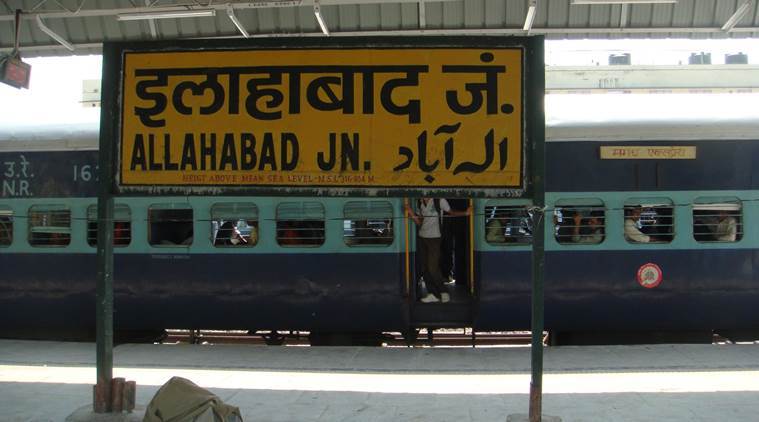
At three, my little brother was an irresistible cutie. He was playing in a sandpit beside a construction site one hot June afternoon when a little girl joined him. She was called Joya and was looking for friends. Her parents were visiting from Bombay and living in an enormous whitewashed bungalow beside our grandfather’s newly built house in Allahabad. She was a few years older to him and since his conversation skills were limited, he brought her over to meet his older sisters. And since friendships formed quite spontaneously without much profiling those days, we all became friends, accessing open fields and each other’s compounds freely. My grandmother didn’t like us bringing friends home so Joya would patiently wait for us outside, every evening.
Allahabad was a thriving metropolis in the 1980s. Indira Gandhi claimed the town as her own and visited as often as she could, the Bachchans lived a few houses away, and every poet, politician, judge, lawyer, and university professor found the city appealing. Our family had already lived a few decades in the city and almost every relative had graduated from the city’s prestigious University. My grandfather had recently retired as a judge in the High Court. My father, was on deputation as a civil servant from Bengal. Even though we were just kids, there wasn’t a nook or cranny that we didn’t know. We spent our summer playing: inventing games, stealing unripe fruit, attempting sporty antics that didn’t often end well, and narrating stories we made up on the spot.
Joya fitted in very well with the three of us. At some point, my brother stopped being a regular fixture and was replaced by another neighbour, a feisty girl called Dimple. Joya and Dimple were the same age. I was a year older and my sister was the youngest in our group. Her mother introduced us to scrabble and her father to golf – we’d watch him practice his short game and putt away on his lawn for hours. Joya had an enviable collection of dolls with pretty paper dresses that appealed to my sister. They would dress and undress them as the heat raged through the day.
Since she was the only child of her parents, Joya was often privy to adult gossip. Which is how we discovered that her family were educators from Bengal who had settled in Allahabad and bought property opposite Company Gardens that also hosted the Science Faculty of the University. We could see its tower looming high over the vegetation, orienting us around town. It was our local Qutub Minar. Joya’s maternal grandfather had several sisters, all of whom had a house in this ample, undemarcated compound, dedicated to the bulbul. They were very close as a family, and walked in and out of each other’s homes like characters in a Christie mystery.
The four of us often invited ourselves to tea with her aunts and grandaunts who also, regaled us with local gossip and dacoit stories. They all made great conversations in English clipped with accent the British had left behind. Their children had moved for better opportunities outside the city. Delhi, Bombay, Calcutta… some had even gone further afield, leaving behind a colony of retired matriarchs. Allahabad was emptying out its youth and the distance between the young and the old was only expanding with every passing year.

As the summer gave way to monsoon, Joya announced that she was returning to Bombay. She also told us that her parents were selling all their property in the city. We were playing in an overgrown field. “This is my land,” Joya informed us. “My parents are keeping this for me should I need it in future.”
As the day of their departure neared, her mother proposed we organise a concert for the neighbourhood. Joya scripted a play. I’m not sure who she took as inspiration because it was about a drunkard who kidnaps two little girls to shake their parents for ransom to feed his addiction. Dimple played the drunkard and I was his glamorous sister. My sister and Joya were the victims of our avarice for money and alcohol. We performed before a packed audience consisting of every neighbourhood aunty who had served us tea and snacks. To make it all real, we even poured Thums Up into a bottle of alcohol Joya’s father emptied from his bar. The verandah was our stage, we entered and exited from the living room doors. Our audience sat on the portico and spilled over onto their lawn. A few cameras flashed at us as we clinked our glasses to a successful abduction.
The play was a raging success. Nature played its part by producing a lightening as the finale when the drunkard and his sister watched their plan come to a tragic end. We received an applause that was only drowned by thunder. My high of having performed so brilliantly however, was dampened when my aunts who were in the audience, chastised me for putting up such a realistic drunken act. “Who taught you to drink like that?” “Shameless girl – at least your sister was the innocent victim.”
It was a whole summer before Joya’s parents would finally sell their house. She continued to visit and we continued to play, forming a children’s club in a tree stump and on one occasion, inside a garbage hole only to be driven out unceremoniously by the neighbourhood cleaners.
Coincidentally, with Joya’s home changing owners, it was time for us to move to Calcutta. My father left in August and was seen off by a large delegation of friends and family. My grandfather was in Delhi with the Law Commission and our large family home had fewer permanent residents. We would stay on until spring to finish the school year and start a new life in Calcutta. Plenty happened in the interim – Indira Gandhi’s assassination, unending curfews, a grand election won on sympathy, and what seemed to be a pogrom against Sikhs. As the north Indian winter dissipated its fog to give way to the festival of Holi, we packed and left for Calcutta. This is where I would make my life my own. Allahabad swiftly drifted into memory.
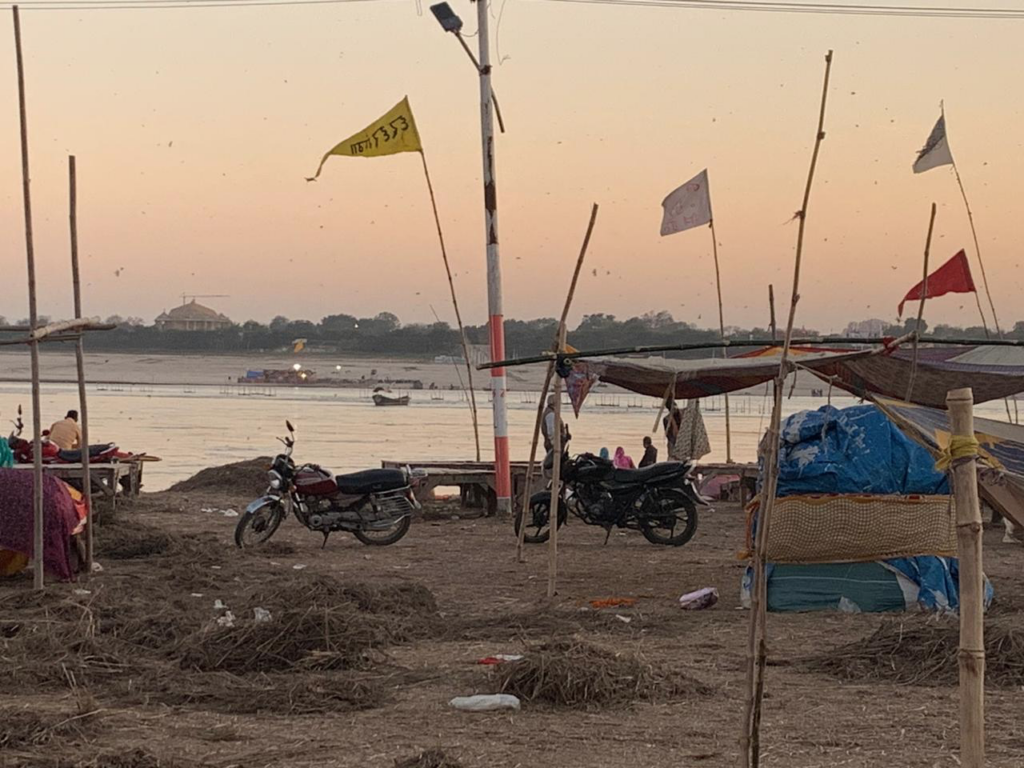
I often reflected on my time in Allahabad and each time I did, the memory of spending the summer with Joya would always spring to my mind as the most pleasant. As it did for my sister. We’d often wonder what became of her… if she had married, if she had a family. And since my network is wider than most people I know, I told my sister I’d find her. Somehow.
Before she left, Joya had scribbled her address on a piece of paper and begged us to stay in touch. Unsurprisingly, that paper was lost. But, I remembered the locality where she lived. I also remembered her last name and sundry details about her father’s family (how his ears had been pierced as a boy because they were Saraswat Brahmins and how like my father, he was the only brother with many sisters). One day, while browsing through an autobiography of a rather famous author while in fact waiting for a friend to take me to the cinema, I found a photo of Joya’s parents. That was my clue. I only had to find this famous author to get to my friend.
I never got round to it.
My sister prodded me again, last week. I blame it on the pandemic and my recent obsession with tying loose ends and not having any regrets and all that, for this time, I didn’t flinch. I contacted a friend in Bombay who is friends with Joya’s famous aunt and seconds later, I had a number. I sent her a message and received the warmest response. Photographs followed and I saw our childhood reflected in her mature gaze. What struck me however, is that even though we spent decades apart, we had chosen the same profession and walked a similar path, albeit in different locations. Yes, she was very happy to be found.
Oh yes, we will stay in touch and meet for real… if there’s anything I’m taking away from 2020 is how to find joy(a) in friendships, no matter how fleeting, fanciful, and far they seem.
PS: None of the cities mentioned in this blog have retained their names
The writer, and the other stuff.
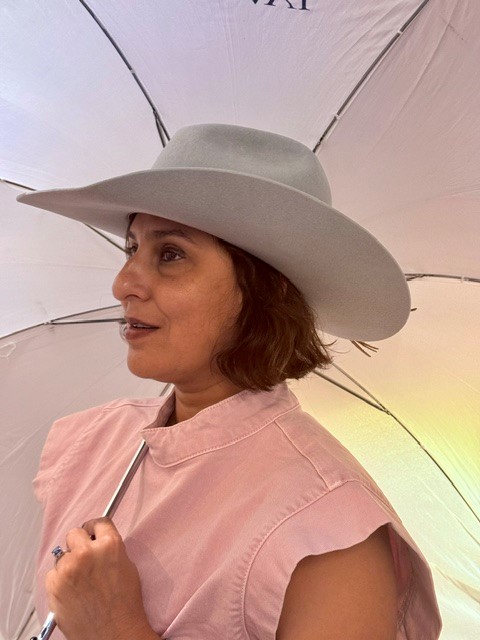
Hello. I’m Gitanjali — development practitioner, sometime author, full-time mother, and very part-time golfer. I’ve spent the last two decades working across South Asia, West Africa, and bits of the world in between, mostly on polio eradication, regional integration, global health, and gender.
This site is a collection of essays I started writing during the pandemic and never quite stopped. Some are field notes. Some are rants. Some are about the strange things you notice on a video call when you’re on your thousandth one. They are written from Switzerland, where I now live with my husband and our daughter.
Writing is how I figure out what I actually think. I publish in case any of it is useful — or, at minimum, mildly entertaining — to you.
If you’d like to get in touch, you can find me through the usual channels. Otherwise, thank you for reading.
3 Comments
Rekha Chaturvedi
Full of nostalgia, an elaborate account of childhood, affection, innocence and friendship. Also covers snippets of political history. The regret of separation and joyous fulfilment of discovering an old dear friend are enjoyable to read.
Ritu
Such a refreshing childhood memory .. I could relate to it as I have changed towns several times during my childhood and have managed to stay in touch with some of my friends and the search goes on for few others.
Mandakini
Beautiful, evocative vignette with gentle humour, and subtle nuances and details. Really enjoyed reading it!