Afghanistan – since I had to…

I volunteered to work for the polio programme in Afghanistan in 2008, fresh from my first international assignment in Nigeria. It was only in 2010 that this materialised. I spent half a year with UNICEF working on eradicating polio, a job that came quite naturally to me since I wrote my book, but nothing had prepared me for the complexities that came with working in a country that had only known conflict. At the end of six months, I was weary and weatherbeaten. But Afghanistan was a drug that was hard to shake. So I returned.
This time, I transitioned from polio (and public health) to regional integration and from UNICEF to the World Bank. And since bringing women together was considered to be a way to harness South Asia’s soft power, I recast myself as a gender and development expert.
Not much had changed between my two assignments. The city looked much the same – dusty and busy with endless traffic jams during the week. Afghans picnicked a lot – parks and woodlands were flooded with families tucking into fragrant, steaming pulav and kebabs on weekends. There was one noticeable difference – there were fewer ISAF vehicles patrolling the city. Consequently, the network was better. Shaken by frequent attacks, the UN stayed in their fortified compounds, one of which had provided me refuge in a 20 foot container, and continued to do their daily radio checks and security drills. On each of my missions, I got a mandatory security briefing and was handed safety gear – a kevlar vest, helmet, radio, and a really basic Nokia phone.
Luckily, I was working on seven other South Asian countries, so this feeling of captivity was temporary. Also, I knew how to get around…
In many ways, the regional integration assignment was far more exciting than the persistent polio eradication task. Harnessing (women’s) soft power meant I could look at all kinds of cultural activities that provided women and girls with employment. So I met pop stars and fashion designers and discovered that (with the exception of security considerations) their life was no different from their contemporaries in India or Nepal. They battled the same deadlines and creative blocks. They worked through the night and passed out in the morning. They forgot to shop. They forgot to eat. They reminded me SO MUCH of my friends back home.
There were also bloggers, coders, and girls discovering technology. Girls who found the internet to escape to a world that was free. Girls with stars in their eyes who were daring to nurture big dreams. That was the new Afghanistan.
And then there were official government projects aimed at empowering women. Those that focused on boosting rural livelihoods and entrepreneurship. Those that got donor funding and approval. Like groups of women getting together to make potato chips and supplying them to kids in a local school. Yes, potato chips to school kids. Never mind long term health implications. Or countless female tailors giving each other competition in a recently electrified village. I could never understand why tailoring was considered to be such a profitable skill. Useful and practical, yes. But profitable?
Most of these projects were managed through the Ministry of Rural Reconstruction and Development. World Bank funding had ensured a youthful buzz and dynamic leadership. Unlike many other ministries, things seemed to magically (and efficiently) get done. So when we moaned about the need for a gender expert in project teams, I was proudly informed that the position had been filled.
Who is the gender expert? I asked during a follow up meeting with the team. A youngish man with a flowing beard smiled: I am.
I drove back bewildered and unable to fully comprehend why a gender role in a male-dominated society would also fall on a man. There was such dichotomy in the two worlds in Afghanistan – the young, dynamic, progressive rapidly urbanising country where young girls had aspirations and the traditional, conservative, mostly rural one that struggled to give space to their female population. Somewhere, the two had to engage.
The Ministry of Women’s Affairs straddled the two worlds. Or attempted to. Visiting them in their fortified compound was like entering a desert oasis with manicured, rose scented gardens and bubbling fountains. Women workshopped and learned different skills – tailoring (but of course), embroidery (why not), knitting (it’s all connected, and this keeps you warm), food processing, pickle and jam making (no potato chips). But there was more. There were brightly lit classrooms where girls were trained to market their products. A mini-MBA module inspired by the countless marketing courses for home entrepreneurs taught them the importance of costing their products right, factoring in their labour costs, and calculating, as accurately as they could, the time they spent in production. They learnt how to understand their market and showed me results of the market surveys they had conducted in their neighbourhoods.
Did they feel equipped to go out there and sell? Oh yes. The Ministry also had little shops where a little bazaar selling women’s produce flourished. That was certainly an option.
In many ways, Afghanistan was no different from India. Women felt safe in artificial bubbles. Everywhere else was bad-land.
Even though all projects through different ministries aimed at economic empowerment, none dared to question (forget addressing or raising awareness) entrenched gender roles and masculinity. Once women get their hands on money, they will automatically gain respect, I was told. Except I don’t think many women got their hands on much money. Profits were almost always reinvested, and those who did save, ended up buying a ticket to the United States. The woman supplying potato chips to the school was one of them. She chose not to conquer the markets of the Central Highlands but to abandon her workshop and (project funded) chip making machinery for greener pastures. She also left way before the coders and techno-geeks who clung to their vision of Afghanistan until the very end. The oasis that was the Ministry of Women’s Affairs got shut down and then sported a new signboard: Ministry for the Promotion of Virtue and the Prevention of Vice. Another oasis, I am guessing. But, just not for women.
I haven’t returned since November 2013. Since I lost my neighbour and a colleague in the same attack in January 2014. The drug kinda wore off.


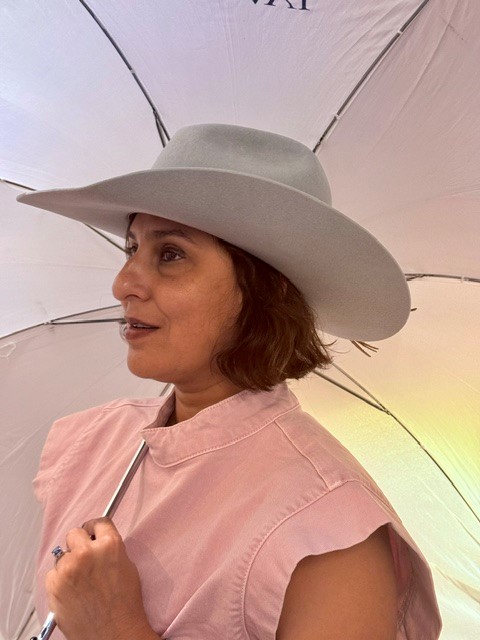
The writer, and the other stuff.
Hello. I’m Gitanjali — development practitioner, sometime author, full-time mother, and very part-time golfer. I’ve spent the last two decades working across South Asia, West Africa, and bits of the world in between, mostly on polio eradication, regional integration, global health, and gender.
This site is a collection of essays I started writing during the pandemic and never quite stopped. Some are field notes. Some are rants. Some are about the strange things you notice on a video call when you’re on your thousandth one. They are written from Switzerland, where I now live with my husband and our daughter.
Writing is how I figure out what I actually think. I publish in case any of it is useful — or, at minimum, mildly entertaining — to you.
If you’d like to get in touch, you can find me through the usual channels. Otherwise, thank you for reading.