Pandemic papers…
We were flying to Lisbon when I noticed for the first time, a tiny New York Times column about a new coronavirus that had come from the wet markets of Wuhan and spread across Hubei province in China. Having worked on infectious diseases before, we public health enthusiasts were in the habit of predicting the next apocalypse. SARS, MERS, H1N1, Ebola – they had all been truly disappointing.
“You’ve got to read this,” I nudged my husband sprawled onto the seat beside me. He looked at the article and shrugged. “Seems to be localised to one province. They’ll have it under control in no time,” he said.
Famous last words.
As COVID-19 crawled its way from China to Europe and very soon, to the rest of the world, I watched with horror and amazement, the response of citizens and governments to the disease and equally, the way the pandemic unfolded in unpredictable ways. As we started to lock down provinces, regions, and countries, I witnessed a thriving community retreat behind closed doors. An unearthly silence descended in our once-effervescent neighbourhood. Although spring was round the corner, birds stopped chirping.
I kept a journal of the first three weeks as our lives evolved towards an inward looking, home bound routine. I started to find parallels in how we had fought polio and how this unknown coronavirus was being “handled.” There were important public health lessons, behavioural lessons that could help keep us safe. I wrote this piece for the Identities Virtual Symposium in April. In the absence of a vaccine or treatment protocols, behaviours were important.
Also, the polio programme in India had developed a very sophisticated system of contact tracing. In April, India’s COVID-19 cases were still under control, and despite the impromptu lockdown, opinion was divided on community transmission.
There were so many facets of this pandemic that (to me) seemed fascinating. So I studied and discussed these with colleagues, students, and in study circles. I realised very quickly, that while many of the public health messages that were being propagated were similar to those communicated for polio or Avian Influenza, digging deeper made me realise that these went as far back as… the bubonic plague of the 14th Century. You can read more about that here.
Women have suffered disproportionately during this pandemic, their work has doubled and their formal jobs have dwindled. You can read about that here. Homes that were once their refuge, were no longer safe as instances of domestic violence became rampant. Again, there was hardly much difference in domestic abuse by geography. What was different, was redressal and support. And that disparity between the global north and the global south, presented the very strong likelihood of regressing on all developmental milestones that had so far been achieved.
The pandemic is far from over and my observations and documentation of life will find their way here. I’d love to hear how life is changing/has changed for you. If things were to revert to pre-pandemic days tomorrow, what would you miss most about life now?
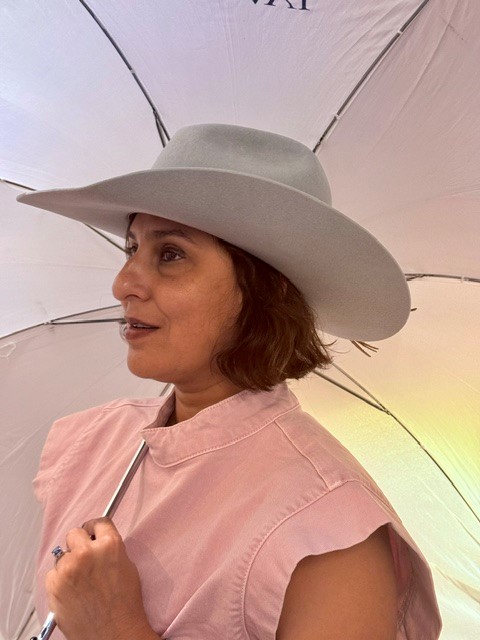
The writer, and the other stuff.
Hello. I’m Gitanjali — development practitioner, sometime author, full-time mother, and very part-time golfer. I’ve spent the last two decades working across South Asia, West Africa, and bits of the world in between, mostly on polio eradication, regional integration, global health, and gender.
This site is a collection of essays I started writing during the pandemic and never quite stopped. Some are field notes. Some are rants. Some are about the strange things you notice on a video call when you’re on your thousandth one. They are written from Switzerland, where I now live with my husband and our daughter.
Writing is how I figure out what I actually think. I publish in case any of it is useful — or, at minimum, mildly entertaining — to you.
If you’d like to get in touch, you can find me through the usual channels. Otherwise, thank you for reading.